
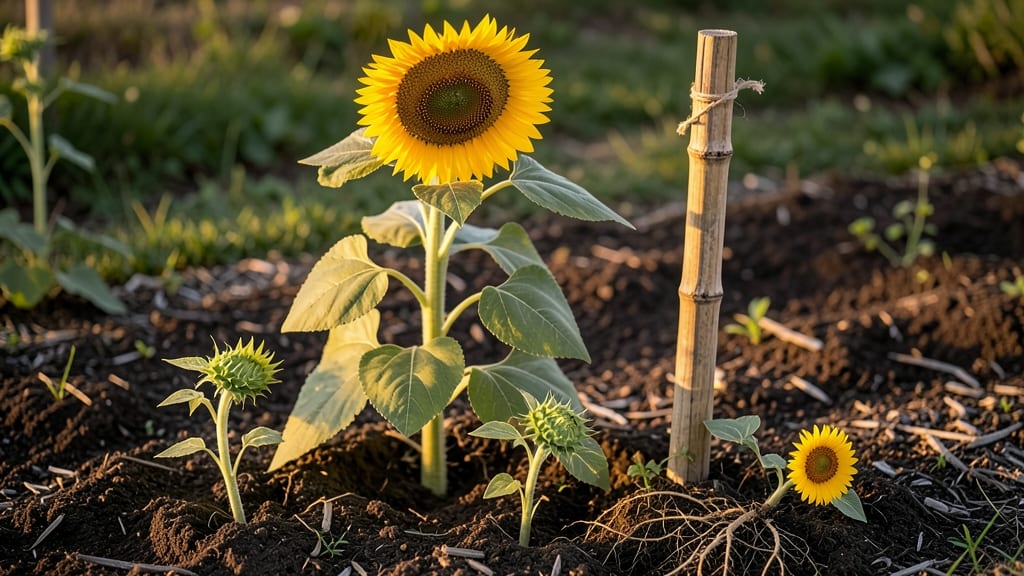
Do Sunflowers Need to Be Staked: When and How to Support Tall Varieties Naturally

Light Requirements

Do Sunflowers Need to Be Staked: When and How to Support Tall Varieties Naturally

Do sunflowers need to be staked when they reach 8 feet or taller, especially in windy areas where their heavy heads can topple stems like overloaded skyscrapers?

Picture this: a 12-foot sunflower 🌻 swaying dramatically in a summer breeze, its petals flapping like a flag of surrender. That’s not just dramatic—it’s a real risk for varieties like ‘Mammoth’ or ‘Russian Giant,’ where staking isn’t optional, it’s survival insurance.

But here’s the twist: dwarf sunflowers like ‘Teddy Bear’ or ‘Pocket Sun’ stand proudly without support, while even mid-height varieties can often go stake-free if planted in sheltered spots or grouped in clusters for mutual support.

Below, I’ll break down the key factors—height, wind, soil, and variety—that decide whether your sunflowers need staking, plus natural support methods that keep your garden looking effortlessly chic.

When sunflowers need staking: height, variety, and wind resistance factors

Sunflowers grow with remarkable speed, shooting up to 10+ feet in a single season. But their towering stems aren't always sturdy—especially when faced with wind gusts or heavy rain.

The need for staking depends on three key factors: sunflower variety, mature height, and local climate conditions. Dwarf varieties like 'Teddy Bear' (1-3 ft) rarely need support, while giants like 'Mammoth' (12-14 ft) often wobble like unsecured skyscrapers.

Sunflower stems contain lignin-rich fibers that provide natural rigidity, but this strength varies by genetics. Hybrid varieties often have thicker stems than heirlooms, but even they can snap under 50+ mph winds.

The taproot system anchors them, but shallow roots in sandy soil reduce stability. If your garden is exposed to prevailing winds, staking becomes a survival strategy, not just an aesthetic choice.

The science of sunflower stability reveals that stems bend at the base where lignin density is lowest.

This weak point is why most sunflowers topple at the soil line rather than mid-stem. Wind resistance also depends on the plant's leaf surface area—broad leaves act like sails, increasing the risk of stem fatigue over time.

Even well-watered plants can suffer if their structural support isn't matched to their height.

Here’s how sunflower height directly correlates with staking needs, along with variety-specific recommendations to help you decide when to invest in support:

Variety Type Mature Height Stem Strength Wind Resistance Staking Recommendation Best For
Dwarf Varieties 1-3 ft Very Strong High (compact structure) No staking needed Containers, borders, urban gardens
Semi-Dwarf 3-6 ft Strong (thick stems) Moderate (depends on wind) Optional staking in windy areas Cut flower gardens, mixed borders
Standard 6-10 ft Moderate (thin stems) Low (top-heavy) Recommended staking in all but sheltered spots Cut flowers, focal points
Giant/Tall 10-14 ft Weak (long, thin stems) Very Low (high wind sail) Essential staking for survival Specialty gardens, exhibition plants
Environmental Factors — Wind Speed Staking Impact —
— 0-10 mph None (natural stability)

Natural staking methods for sunflowers: DIY supports without spoiling their look

If you’ve ever watched a sunflower sway dramatically in the wind, you know why staking might seem like a no-brainer. But the good news is you don’t need unsightly metal stakes to keep them upright.

With a little creativity, you can use natural materials already in your garden to provide support that blends seamlessly with your landscape. These methods not only keep your sunflowers standing tall but also add rustic charm to your garden design.

Before grabbing a stake, consider your sunflower variety and growing conditions. Dwarf varieties like 'Teddy Bear' often stand alone, while tall hybrids like 'Mammoth' or 'Russian Giant' may need extra love—especially in windy areas.

The key is to mimic how sunflowers grow in the wild, where they lean against other plants or use their own weight to stay stable. Let’s explore some of my favorite DIY staking hacks that keep your sunflowers looking effortlessly natural.

🌱 Natural Staking Solutions for Sunflowers

  • 🌾 Cornstalk Cages: Harvest a few cornstalks after your corn is done and weave 3-4 together into a loose cage around the sunflower. Secure with soft garden twine—this lets the plant move slightly with the wind while staying upright.
  • 🌿 Pea Trellis Hack: Repurpose old pea trellises or bamboo stakes by tying them loosely around the sunflower stem. Space them every 12 inches for stability without restricting growth.
  • 🪴 Bamboo or Reed Bundles: Bundle 3-5 bamboo stakes or reeds together and tie them at the base of the sunflower. This creates a natural windbreak while keeping the look organic.
  • 🌻 Sunflower Cluster Planting: Group 3-5 sunflowers together in a tight circle. Their stems will lean against each other, creating a self-supporting "tower." Perfect for windy gardens!
  • 🌿 Tall Grass or Reed Windbreaks: Plant switchgrass or reeds nearby to act as a natural windbreak. Their swaying motion also adds movement to your garden.
  • 🪣 Twine-and-Stick Spiral: Tie a soft twine around the sunflower stem in a loose spiral, securing it to a nearby sturdy stick or plant. This mimics how vines naturally climb.

When using any of these methods, avoid tying the sunflower stem too tightly—this can restrict growth and cause the stem to weaken. Instead, use soft materials like garden twine, old fabric strips, or even strips of an old T-shirt.

These gentle ties allow the stem to flex slightly, which actually strengthens it over time. Think of it like giving your sunflower a supportive hug rather than a straitjacket.

For extra-tall varieties, consider planting them near a fence or trellis. If you’re growing sunflowers along a perennial border, let them lean against taller plants like hollyhocks or delphiniums.

This not only saves you from staking but also creates a stunning vertical display. The best part? Your garden will look like it was designed by nature itself.

One of my favorite low-maintenance tricks is to plant sunflowers in a sheltered spot, like the lee side of a hedge or building. This reduces wind exposure dramatically, often eliminating the need for staking altogether.

If you’re in a very windy climate, combine this with a loose cornstalk cage for added security without sacrificing aesthetics.

Remember, the goal isn’t to create a rigid, manicured look—it’s to help your sunflowers thrive in a way that feels natural and intentional. With these methods, your sunflowers will stand tall, sway gracefully, and still turn heads in your garden.

Now, go ahead and let your creativity (and sunflowers) shine! 🌻

★★★★★5.0(4 reviews)
Categories Light Requirements